The Bean Journey & Anaerobic Process
Harvesting
Cultivated at the highest altitudes of Guji, our coffee grows within a rich polyculture ecosystem. The cherries mature slowly under the dense canopy of indigenous shade trees including Enset, Albizia, and Acacia which preserve soil moisture and nutrient density. Our harvest occurs at the peak of sugar concentration, strictly between late November and mid-January, ensuring only the densest cherries are selected.
Sorting & Processing
Quality is defined by what we leave out. Upon delivery, every lot undergoes intensive manual sorting. Our team individually inspects the harvest to separate over-ripe and under-ripe cherries from the “blood-red” selection. This rigorous hand-sorting is the foundation of our Grade 1 status, ensuring a uniform fermentation across the entire batch.
Anaerobic Fermentation
To unlock a “punchy explosion” of fruit, we utilize an oxygen-free environment. The sorted cherries are sealed in airtight stainless steel tanks equipped with one-way valves for off-gassing.
The Science: By removing oxygen, we limit microbial activity to specific strains that thrive in anaerobic conditions, allowing the coffee to ferment slowly over several days.
The Control: We maintain a strict pH range of 4.5 to 4.8 and ambient temperatures between 18-25°C.
Consistency: Barrels are rotated three times daily to ensure even contact and a balanced, complex flavor profile that traditional methods cannot replicate.
Controlled Sun-Drying
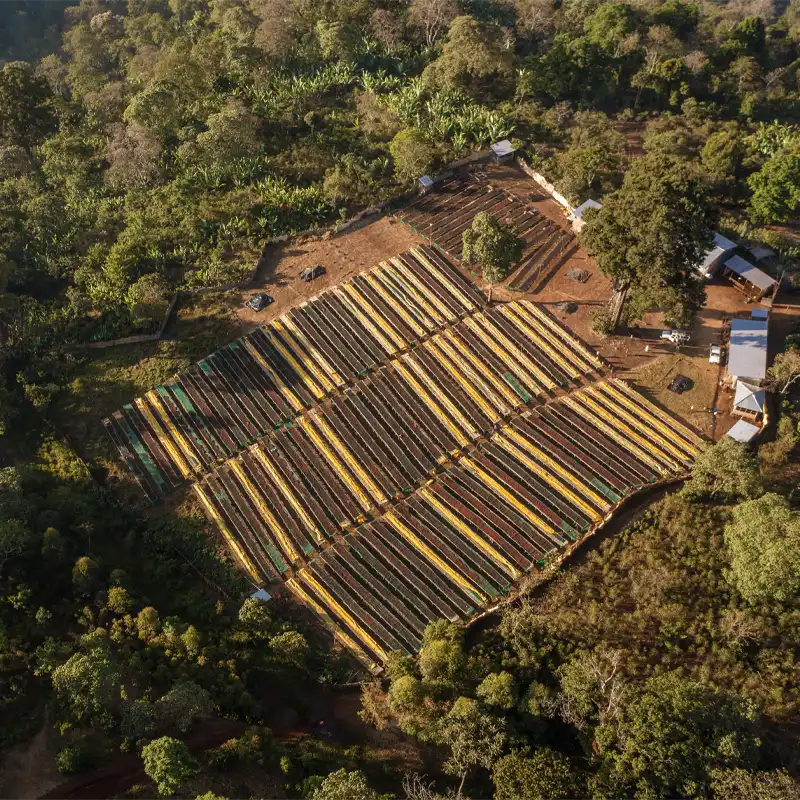
The final profile is stabilized on raised African beds using traditional sun-drying techniques. Over a period of 12 to 15 days, the beans are carefully turned to respond to local wind and sunlight patterns. This slow, natural evaporation continues until the beans reach an optimal moisture content of 10-12%, locking in the winey acidity and tropical sweetness developed during fermentation.